
Belong and Prosper
Spock's legacy treks to the Annual Gathering with Leonard Nimoy's family and the advocates advancing its work in neurodiversity

Leonard Nimoy spent years hearing from fans who felt an unexpected affinity for the character he was best known for playing, Star Trek’s Mr. Spock. Not just admiration, but recognition. Certainly among scientists and engineers, programmers and mathematicians, physicians and academics, but also many others who saw their own way of thinking in Spock’s: analytical, literal, and often out of step with a more socially intuitive world.
In the years since Nimoy’s death in 2015, that response has been more clearly named, particularly within the autism and broader neurodivergent community. What fans had long described informally is now understood as something more specific — a shared cognitive style reflected in a fictional character.
Temple Grandin, a scientist and one of the most widely known advocates for people with autism, captured that experience when she wrote about Spock after Nimoy’s death: “When I was an awkward teenager who did not fit in with the other kids, the logical Mr. Spock was a character I could really identify with.”
For Grandin, the connection was not abstract. Spock’s reliance on logic over emotion helped her recognize her own way of thinking before she had the language to describe it.
That mindset — of Spock as more than a character but a mirror for how some people process the world — is at the center of upcoming Annual Gathering sessions featuring the world premiere of a newly remastered version of Remembering Leonard Nimoy, directed by his daughter, Julie Nimoy, and filmmaker David Knight, along with appearances by his son, Adam Nimoy, and Tara May, CEO of Aspiritech, a nonprofit that employs and supports neurodivergent professionals. Through the Nimoy-Knight Foundation, Julie and David have helped turn that long observed dynamic into a platform for advocacy, education, and public conversation.
Leonard Nimoy did not set out to create that kind of reaction to Spock, but he spent years trying to understand it.

In 1975, he published I Am Not Spock, a memoir that pushed back against how completely the role had come to define him. He was an actor with a wider range of work and interests, he made clear.
Two decades later, in I Am Spock, he returned to the subject with a different perspective, acknowledging what the role had come to mean not just to audiences but to himself.
“My belief is that he wrote I Am Not Spock because he wanted people to understand that he was more than just the alien Mr. Spock, the scientist on the ship,” Julie said. “He loved and admired the character Spock, and to some extent Spock’s personality mirrored some of my dad’s own disposition.”
Over time, she said, Leonard Nimoy came to recognize how much Spock meant, not just in terms of the role’s success but in the way it helped people understand themselves.

“Many people have written to me saying how Dad and the character Spock had changed their lives,” she said. “These people often felt a kinship with the character, and the relationship they felt made them feel inspired. Many people’s careers were affected in a profound way — they became scientists and engineers.”
For those who met Nimoy away from the screen, Julie said, what often stood out was not distance or grandeur but kindness — and a life that extended well beyond a single role.
“When people met my dad outside of work, what surprised them was how warm and welcoming he was,” she said. “My dad did not have a big ego or a bad attitude.”
Off-screen, Nimoy’s interests were wide-ranging. He had been a photographer from a young age, developing film in his parents’ small apartment as a boy, and later exhibited his work in galleries across the country. He built with wood, earned an instrument rating so he could pilot his own plane day or night, and remained active in politics, charitable work, and causes he believed in. Acting was only one part of a much larger creative life. But he never dismissed the role that had connected him to so many people.
That idea is what the Nimoy-Knight Foundation has taken on more directly in the years since his passing. Established by Julie and David, the foundation supports scientific research, arts education, and advocacy around neurodiversity, building on what Nimoy observed but never tried to define too narrowly.
Knight, a producer who has worked with Julie on preserving and presenting Nimoy’s legacy, said a theme became clearer the more they revisited fan responses and archival material. He co-directed Remembering Leonard Nimoy with Julie, a documentary that reflects both Nimoy’s life and Spock’s cultural reach.
“You start to see the same idea come up again and again,” he said. “People weren’t just fans of the character. They felt understood by him.”
Tara May, CEO of Aspiritech, a nonprofit that employs and supports neurodivergent professionals, connected with the Nimoy-Knight Foundation after receiving its Live Long and Prosper Award for her work in neurodiversity advocacy — an honor also given to figures such as LeVar Burton, Whoopi Goldberg, Neil deGrasse Tyson, Bill Nye, and Mayim Bialik, each of whom accepted it with the familiar Vulcan salute, openly embracing Spock’s legacy.
“Many people in the autism and neurodivergent community feel a kinship with Mr. Spock — a highly logical and empathetic character who sometimes struggled to find his sense of belonging in the universe,” May said. “So many of us can relate to that feeling in one way or another.”
At Aspiritech, a Chicago-based organization with more than 100 employees, that approach shapes how the work is structured. The goal is not to reshape how people think but to build environments where those ways of thinking can succeed: with clear communication, reduced sensory stress, and expectations that are explicit rather than implied.

“Aspiritech’s true power lies in accepting people exactly as they are,” May said, “creating a sense of community and belonging, allowing our strengths to shine and our humanity to show.”
For Julie, that arc — from the Spock her father once tried to separate himself from to one that helped people better understand themselves — is part of what makes the work feel continuous. The stories have changed over time, but the core of them has not.
At the Annual Gathering in Fort Worth, that conversation moves into a shared space, where what once felt isolating no longer has to be explained alone. The July 1-5 event includes the world premiere of a newly remastered version of Remembering Leonard Nimoy, directed by his daughter, Julie Nimoy, and David Knight, ahead of its PBS run, with his son, Adam Nimoy, and Tara May participating in related programs. Register at ag.us.mensa.org.
American Mensa Honored with Live Long & Prosper Tribute Award for Work Reflecting Leonard Nimoy’s Enduring Legacy

American Mensa has been named a recipient of the Live Long & Prosper Tribute Award, presented by the Nimoy-Knight Foundation in recognition of work that reflects Leonard Nimoy’s enduring message of logic, service, and the value of diverse ways of thinking.
The announcement, made March 26 in celebration of what would have been Nimoy’s 95th birthday, named American Mensa Chair Jon Gruebele alongside Holden Thorp, Editor-in-Chief of the Science family of journals, as this year’s honorees. Both were recognized as representatives of larger institutions — Gruebele on behalf of American Mensa and Thorp in connection with Science.
Julie Nimoy and David Knight, co-founders of the Nimoy-Knight Foundation, framed this year’s recipients around “the pursuit of knowledge and the empowerment of all minds.”
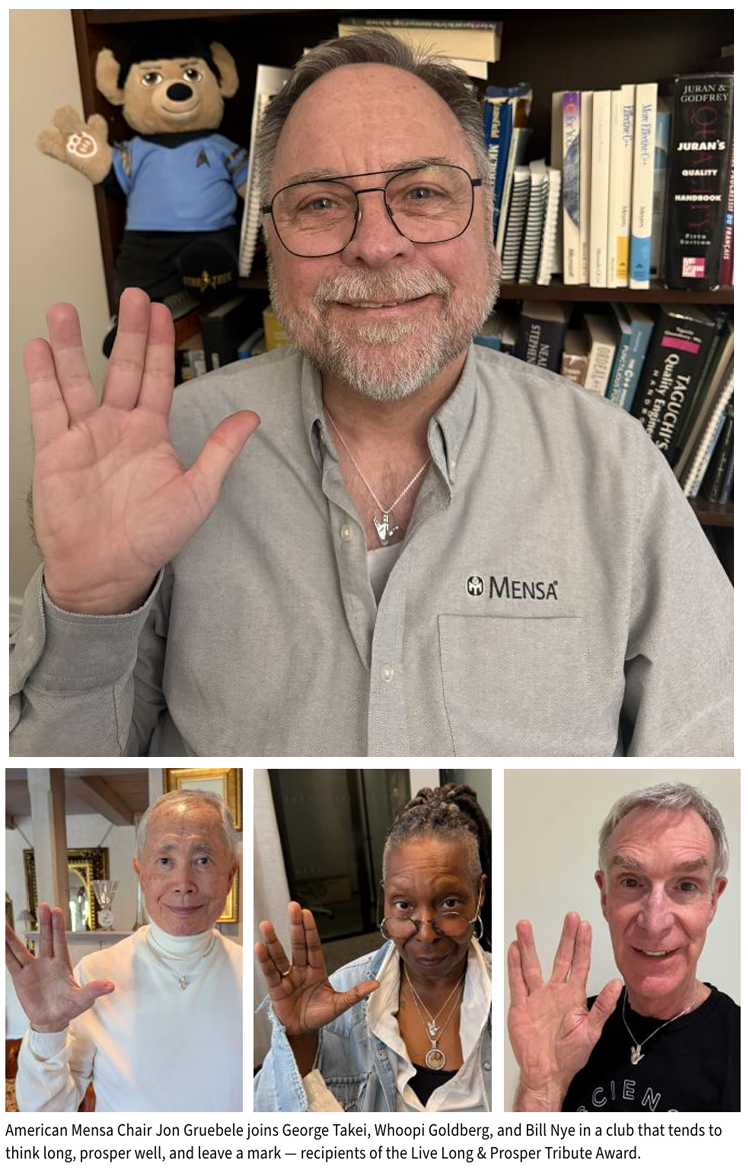
Gruebele accepted the award on behalf of American Mensa, noting what he described as a natural resonance between the two organizations. “Mensa supports intelligence for the benefit of humanity and provides a stimulating social environment for our members,” he said. “The Nimoy-Knight Foundation’s commitment to education and neurodiversity resonates profoundly within our membership. As Mr. Spock, Leonard Nimoy embodied logic and integrity, qualities to which we can all aspire.”
The Live Long & Prosper Tribute Award recognizes contributions across science, education, community engagement, and neurodiversity advocacy. Past recipients include Temple Grandin, LeVar Burton, Whoopi Goldberg, Neil deGrasse Tyson, and Bill Nye, among others.
“Leonard always believed that our differences are our greatest strengths,” Nimoy and Knight said. “There is no better way to celebrate Leonard’s 95th birthday than by recognizing those who help the world live long and prosper.”
Honor Leonard Nimoy’s legacy with a donation to the Nimoy-Knight Foundation or by hosting a screening or special event.
TheNimoyKnightFoundation.org
Info@RememberingLeonardNimoy.org
Info@RememberingLeonardNimoyFilm.com
The Nimoy-Knight Foundation
4335 Van Nuys Blvd
Sherman Oaks, CA 91423
818.788.4905